Lead Yourself First: A Practical Guide to Self-Leadership, Personal Growth, and Productivity
Self-leadership is the skill of directing your thoughts, habits, and choices toward the outcomes you want—especially when motivation is low or life is noisy. It’s less about “pushing harder” and more about building a steady way to choose priorities, manage attention, and keep promises to yourself. The goal is reliable progress you can repeat on ordinary days.
What self-leadership really means (and what it isn’t)
Self-leadership is the ability to set direction, manage attention, and follow through without relying on external pressure. It’s the internal version of good leadership: clear priorities, calm course-correction, and consistent execution.
It isn’t constant hustle, perfectionism, or strict self-criticism. Sustainable self-management protects your energy and makes success more predictable instead of more dramatic.
The core elements tend to look the same across goals: self-awareness (knowing what’s happening), self-regulation (choosing your response), purposeful goals (knowing what matters), and consistent execution (doing the next step even when it’s small). When it’s working, priorities feel clearer, reactive decisions drop, and progress becomes easier to forecast.
For a deeper look at self-awareness as a learnable skill, Harvard Business Review’s breakdown is a useful reference: What Self-Awareness Really Is (and How to Cultivate It).
Start with clarity: values, identity, and one measurable priority
Clarity turns effort into momentum. Start by defining 3–5 values that guide decisions—examples include health, learning, family, craftsmanship, or service. Values help you say “no” faster and “yes” more confidently.
Next, write a simple identity statement: “I’m the kind of person who ___.” Identity-based language keeps habits from depending on mood. “I’m the kind of person who finishes what I start” is a sturdier cue than “I’ll do it when I feel motivated.”
Then choose one measurable priority for the next 14 days. Make it realistic and trackable: output-based (write 300 words/day) or time-based (walk 20 minutes/day). Finally, create a “stop doing” list and remove one ongoing drain that undermines focus—something you can actually control.
Clarity tools that reduce overwhelm
| Tool |
How to use it |
Example |
| Values check |
Before a decision, ask which option aligns with a top value |
Choose a shorter meeting to protect “health” and “family time” |
| Identity cue |
Attach habits to identity instead of mood |
“I’m a finisher” → submit drafts even if imperfect |
| One priority rule |
Pick one measurable target for 14 days |
Write 300 words/day or walk 20 minutes/day |
| Stop doing list |
Remove one recurring distraction |
No notifications during deep work blocks |
Build self-leadership habits that survive busy days
Consistency wins when life is crowded. Use tiny commitments: decide the minimum viable version of a habit (two minutes) so you can maintain continuity even on chaotic days. Two minutes of planning, reading one page, or doing one set still keeps the identity signal alive: “I show up.”
Self-regulation: manage emotions, energy, and attention
Self-leadership gets real when emotions run high. Briefly naming the emotion (“I’m frustrated,” “I’m anxious,” “I’m overloaded”) often reduces its intensity and improves choice quality. The American Psychological Association’s overview of self-regulation helps explain why this matters: Self-regulation.
Match tasks to energy. Do deep work during peak energy and reserve admin tasks for low energy. Protect attention with boundaries: single-tasking, timed focus sessions, and scheduled check-in windows for messages. If your workspace feels dry or stale during long focus blocks, a small comfort cue can support calmer routines—something like the Mini USB Aroma Humidifier & Essential Oil Diffuser with Soft LED Light can help create a consistent “start work” ritual.
A simple weekly system: plan, execute, review, adjust
Weekly rhythm template
| Moment |
Time |
What to decide |
Output |
| Weekly plan |
15 min |
What matters most this week |
1 outcome + 2 habits + 3 key tasks |
| Daily start |
3–5 min |
What makes today successful |
1 must-do + time block |
| Midweek check |
5 min |
What’s blocking progress |
One adjustment (scope, schedule, support) |
| Weekly review |
10 min |
What worked and what didn’t |
One improvement for next week |
Common self-leadership traps (and clean fixes)
Digital guide spotlight: Lead Yourself First
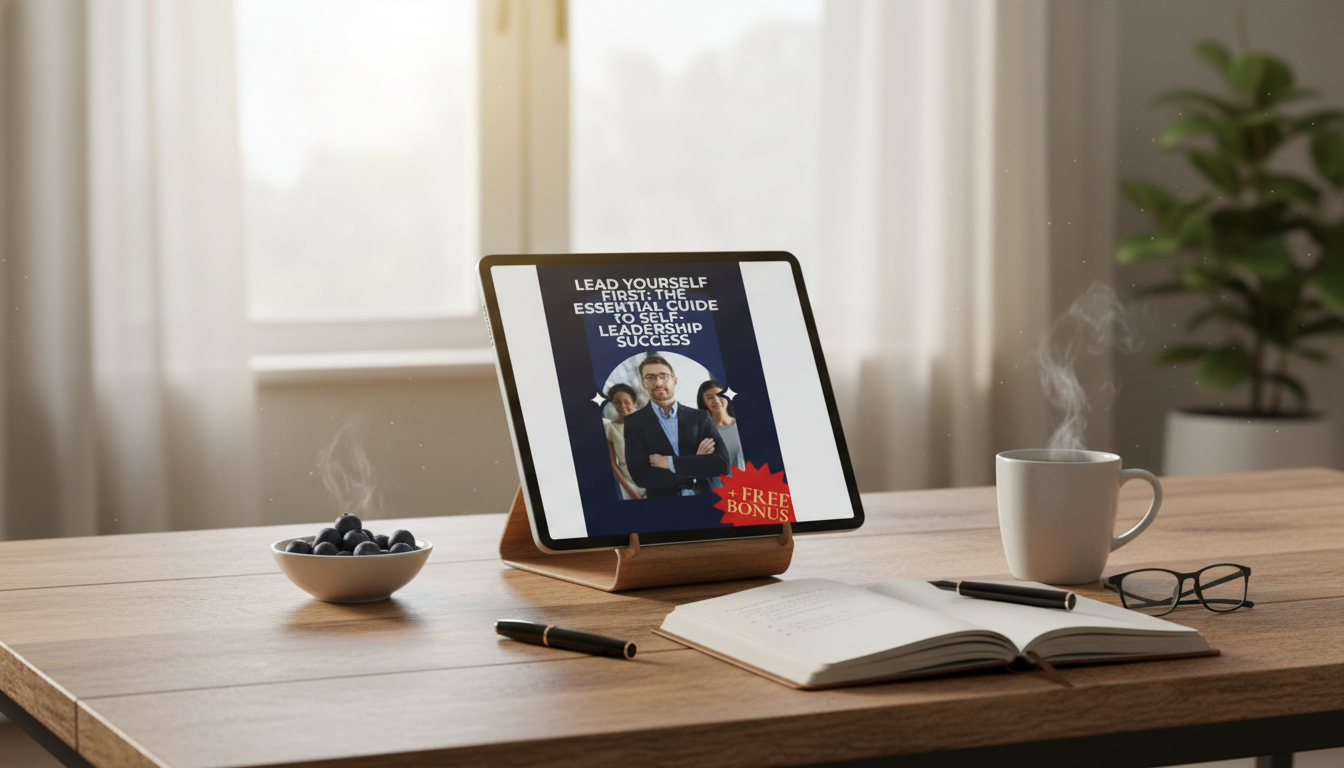
If structured prompts help you stay consistent, Lead Yourself First: The Essential Guide to Self-Leadership Success (Digital Download) is a compact resource built around practical exercises. It fits short sessions—use it as a weekly reset, a daily focus routine, or a quick goal reboot when momentum drops.
Pair it with a simple habit tracker and calendar blocks to keep your system visible. For smoother “set-and-forget” productivity, reliable charging also removes a small but real friction point—especially when you work across devices. The 65W GaN USB C Fast Wall Charger with Quick Charge can help keep your laptop and phone ready so your focus sessions don’t get interrupted by low-battery detours.
FAQ
What is the difference between self-leadership and self-discipline?
Self-leadership is the full package: direction (priorities), systems (habits and routines), and self-regulation (managing emotions and attention). Self-discipline is one component—mainly the ability to resist impulses in the moment. For example, self-leadership might remove temptation by turning off notifications during focus blocks, so you need less willpower.
How can self-leadership improve productivity without burnout?
It improves productivity by narrowing priorities, scheduling work around energy, and using small sustainable habits instead of intensity spikes. Boundaries for attention and a weekly review help adjust the workload before it becomes overwhelming, keeping progress consistent rather than exhausting.
What’s a quick daily routine to practice self-leadership?
Take five minutes: pick one must-do task, choose a specific time block, identify the most likely obstacle, decide the tiniest first step, and end the day with a one-minute review of what worked. This keeps direction clear and makes follow-through easier tomorrow.
Recommended for you












Leave a comment