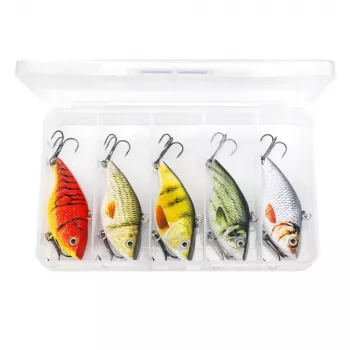
A lipless vibration lure is built to cover water fast, call fish from a distance, and stay effective from shallow flats to deeper breaks. This 5-piece set of 2.75-inch sinking crankbaits is designed for versatility—fan-casting, yo-yoing, ripping through grass, and probing structure—so an angler can adjust retrieve style rather than changing lure families.
What a lipless vibration lure does well
Lipless “vibration” crankbaits earn their spot because they do multiple jobs well without demanding perfect conditions. They’re a reliable choice when you need a moving bait that can be fished shallow, mid-depth, or deeper simply by changing how you work it.
- Sinks on the pause, letting depth be controlled by countdown and retrieve speed
- Tight wobble and strong vibration help fish locate the bait in stained water or wind
- Compact profile imitates common forage like shad, perch, and small baitfish
- Works across seasons: steady retrieves in warm water; lift-and-fall in colder water
- Casts far for bank fishing, flats, and windy points
For general bass fundamentals and seasonal behavior, Take Me Fishing has a solid overview that pairs well with reaction-bait tactics: How to Fish for Bass. For additional lipless crankbait strategy, browse the tips and technique coverage on Bassmaster.
Set overview: size, sink behavior, and where it fits in a tackle box
The 2.75-inch class is a “middle lane” size: small enough to match common baitfish, but substantial enough to draw strikes from aggressive predators. Because these lures sink, they stay useful when fish slide off the bank, when wind pushes bait out over the first break, or when you need to keep the lure down through the retrieve.
- 2.75-inch class targets bass, pike, walleye, and other predators depending on local forage
- Sinking body keeps the bait in the strike zone when fish hold deeper
- 5-piece assortment supports rotating looks and replacing lures after hang-ups or toothy fish
- Lipless designs excel when fish want a faster, more reactive presentation than a jig or soft plastic
Quick setup guide (starting points)
| Situation |
Line |
Rod/Action |
Retrieve cue |
| Shallow grass (1–6 ft) |
30–50 lb braid or 12–17 lb mono/fluoro |
Medium-heavy, moderate/mod-fast |
Rip free on contact; pause after the snap |
| Rock/points (3–10 ft) |
12–17 lb fluoro |
Medium/medium-heavy, moderate |
Steady retrieve; brief pauses near transitions |
| Cold water/slow fish |
10–14 lb fluoro |
Medium, moderate |
Lift-and-fall (yo-yo); bites often on the fall |
| Windy flats/searching |
12–17 lb mono/fluoro |
Medium-heavy, moderate |
Fast enough to feel vibration; cover water in lanes |
Product pick
If you want a simple way to keep multiple lipless options ready for changing light, clarity, and pressure, start with 5pcs Lipless Vibration Fishing Lures Set – Sinking Crankbaits 2.75in. A multi-lure set also helps when you need to retire one after repeated rock contact or a run-in with pike teeth.
For long days on the water—especially when running mapping, photos, or weather apps—a compact power solution can be handy in the truck or at the cabin: 65W GaN USB C Fast Wall Charger with Quick Charge.
How to fish it: retrieves that trigger strikes
Lipless crankbaits respond to small changes. Instead of swapping lures constantly, vary cadence, depth, and contact with cover until the fish “tell” you what they want.
- Steady retrieve: Keep vibration consistent; speed up until it just starts to hunt, then back off slightly.
- Yo-yo (lift-and-fall): Lift the rod tip to make it thump, then let it flutter down on semi-slack line. Watch for the line to tick or jump.
- Ripping grass: Reel until it ticks vegetation, pop the rod to break it free, then immediately continue—many strikes happen right after it snaps loose.
- Stop-and-go: Add short pauses to let it sink; effective when fish follow but won’t commit.
- Bottom ticking: In deeper water, maintain occasional bottom contact without constantly dragging; brief taps can mimic a fleeing baitfish.
Where it shines: water types and target species
A sinking lipless lure is a natural “search bait,” but it’s also a precision tool when you know where fish are holding. The key is matching your retrieve lane to the depth fish are using.
Tackle pairing and small adjustments that matter
Practical care: keeping treble baits ready
When to tie it on instead of other hard baits
FAQ
How deep will a 2.75-inch sinking lipless lure run?
Depth depends on sink rate, countdown time, line diameter, and retrieve speed. As a practical starting point, count it down a few seconds for mid-depth lanes, and extend the countdown for deeper edges—then fine-tune with slower or faster retrieves until you’re ticking the right cover.
Is fluorocarbon or braid better for lipless vibration lures?
Fluorocarbon is a strong all-around option for depth control and sensitivity around rock and hard structure. Braid shines for ripping grass and long casts, and adding a leader can help when abrasion or visibility becomes a concern.
What’s the best retrieve for cold water?
A lift-and-fall (yo-yo) retrieve with longer pauses is a consistent cold-water producer. Keep contact on the fall and be ready for bites that feel like sudden heaviness rather than a sharp “tap.”
Recommended for you











Leave a comment