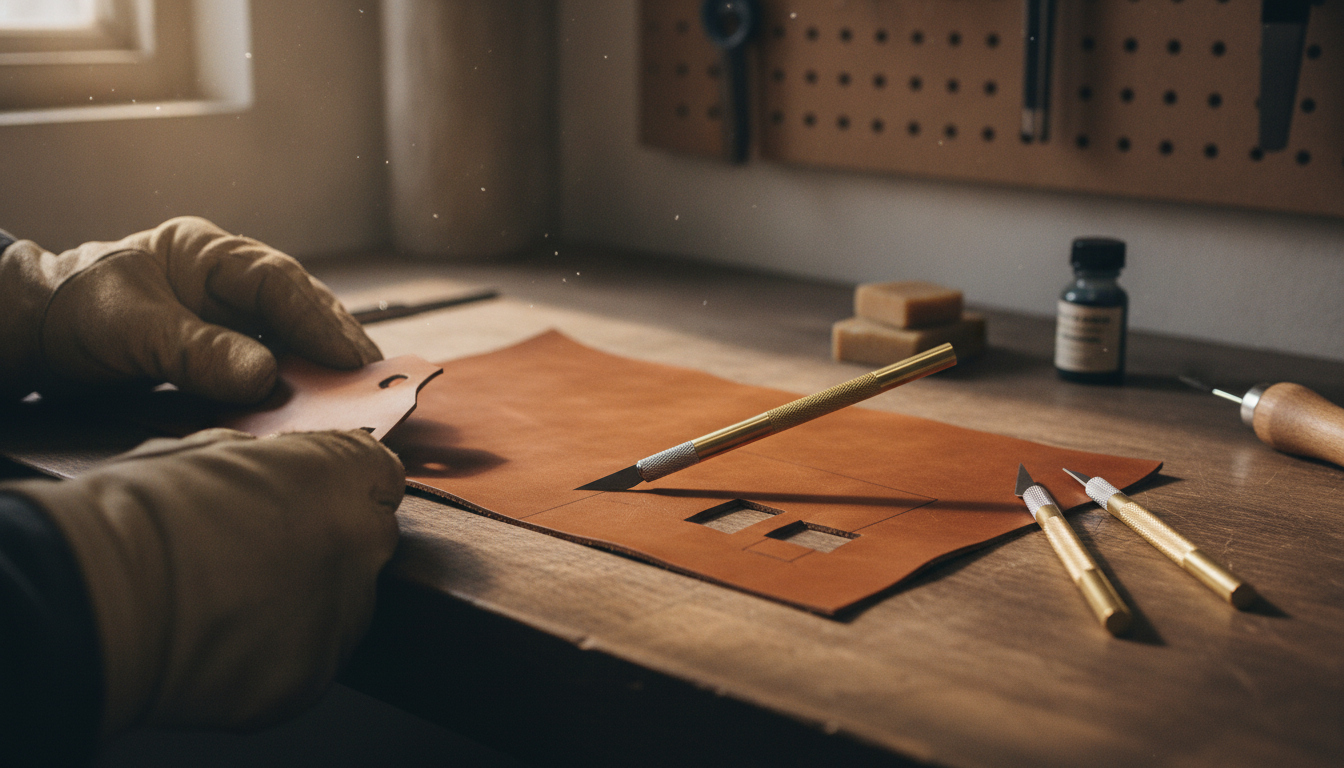
A scalpel-style knife set is built for controlled, accurate cutting—useful for carving lines, trimming edges, and shaping small leather parts where thicker knives feel clumsy. With the right blades, grip, and safety habits, it can handle everything from pattern cutting to fine detail without tearing or stretching the hide.
What a scalpel-style leather knife set is best at
A scalpel-style craft knife shines when the job is small, exacting, and easy to overdo with a heavier blade. The slim handle and replaceable, ultra-sharp tips help keep cuts deliberate—especially when working close to stitch lines, tooling impressions, or tight curves.
- Fine control for short cuts, tight curves, and small adjustments around tooling or stitching lines
- Cleaner starts and stops on cuts compared with bulkier craft knives
- Helpful for trimming thin leather, lining material, and small tabs without crushing the grain
- Works well alongside other leather tools rather than replacing them (swivel knife, edge beveler, skiving knife)
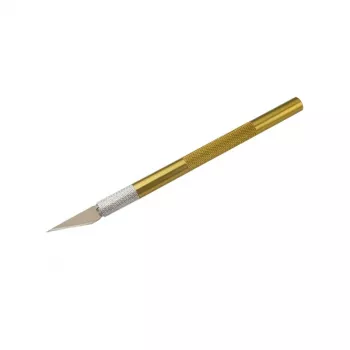
If you’re outfitting a small leather workstation, a dedicated Leather Carving Scalpel Knife Set is an easy way to add precision without committing to a larger specialty knife for every detail task.
Most sets are simple by design, but the small details matter. A secure blade clamp and a comfortable grip do more for accuracy than an oversized handle or flashy extras.
- Handle: slim, pen-like grip for fingertip control; check for a secure blade clamp/collet
- Interchangeable blades: multiple shapes for different cut styles (straight, curved, pointed) and materials
- Protective cap or storage case (if included): reduces accidental nicks and protects blade tips
- Optional accessories: spare blades, small wrench, or blade removal aid depending on the kit
A small but practical upgrade is keeping a labeled container for different blade shapes so you can swap quickly without guessing which profile you grabbed.
Choosing the right blade shape for the task
Leather behaves differently depending on temper, finish, and thickness. Matching the blade shape to the cut helps prevent snagging, wandering, and stretched edges.
- Straight edge blades: best for long-ish guided cuts along a ruler and for trimming edges flush
- Curved blades: useful for arcs, rounded corners, and controlled slicing motions on softer leathers
- Fine point blades: suited to tiny cut-ins, piercing starter points, and detailed pattern trimming
- Stiffer vs. thinner blades: stiffer blades feel more stable on thicker leather; thinner blades excel on light leather and films
For clean results, think “slice” more than “push.” Even a perfect blade profile will struggle if it’s driven straight down with too much force.
Where it fits into leathercraft workflows
A scalpel set is most useful as a precision companion tool. It’s the knife you reach for after the main cut is made, or when a part is too small to safely control with a utility blade.
- Pattern cutting: cut paper templates, then refine leather edges with small corrective trims
- Carving and detail trimming: clean up around stamped/tooling areas and crisp corners
- Skiving and thinning (light duty): shave small areas gradually; avoid aggressive prying to prevent blade snap
- Repair tasks: trim patch edges, remove loose fibers, and clean up old adhesive lines carefully
For leather repair or refresh work after trimming and patching, a finish product can help even out appearance. If you’re restoring automotive trim or coated leather surfaces, Car Plastic & Leather Restorer – Back to Black Gloss Coating & Polish can be a handy follow-up step once the cut and cleanup work is complete.
Technique tips for cleaner cuts
Precision cutting is mostly technique: stable workholding, consistent angle, and fresh blades. Small changes—like switching to a better cutting surface—often improve results more than switching tools.
- Use a proper cutting surface: self-healing cutting mat or dense poly cutting board helps prevent tip damage
- Let the blade slice, not scrape: lower the angle and use steady pulling strokes to reduce jagged edges
- Make multiple light passes: on thicker leather instead of forcing one deep cut
- Stabilize the leather: tape the template, use weights, or use a non-slip mat to prevent shifting
Scalpel knife vs. other common leather cutting tools
| Tool |
Best for |
Limitations |
Typical leather tasks |
| Scalpel-style craft knife |
Precision trimming, tight curves, detail work |
Blades can snap if twisted; not ideal for heavy straps |
Pattern trimming, detail cut-ins, small skives |
| Utility knife/box cutter |
Long straight cuts with sturdy blades |
Less nimble for small curves and fine corners |
Strap cutting, straight panels, rough sizing |
| Swivel knife |
Tooling/casing cuts for decorative carving lines |
Not for through-cuts; learning curve |
Decorative carving, filigree guide lines |
Safety habits that matter with scalpel blades
General guidance for hand-tool safety is also covered by authoritative workplace resources like OSHA’s hand and power tools safety overview and the UK HSE hand tools safety guidance.
Blade changes, storage, and basic care
For background on what a scalpel is designed to do (and why the blade geometry feels so different from a utility knife), see Encyclopaedia Britannica’s overview of the scalpel.
When a scalpel set is enough—and when to add another tool
FAQ
Can a scalpel knife cut thick leather cleanly?
It works best on light to medium thickness with multiple light passes. For thick straps or very dense hides, a heavier utility knife or head knife is usually safer and faster.
How often should scalpel blades be replaced for leatherwork?
Replace the blade as soon as cuts start dragging, fraying fibers, or requiring extra pressure. Fresh blades improve control and reduce the chance of slips.
What surface should be used under leather when cutting with a scalpel?
Use a self-healing cutting mat or a dense poly cutting board. Avoid glass, stone, or metal surfaces because they dull and chip blade tips quickly.
Recommended for you












Leave a comment